If your dashboards read ABS Labour Force occupation data, the OSCA occupation classification change will reach your pipeline this spring. From the September 2026 reference period, the Australian Bureau of Statistics moves all Labour Force Survey occupation data to OSCA, the Occupation Standard Classification for Australia. The headline release also returns to the third Thursday of the month, first on 15 October 2026. This post explains what changes and what to fix before that date.
What the OSCA occupation classification change involves
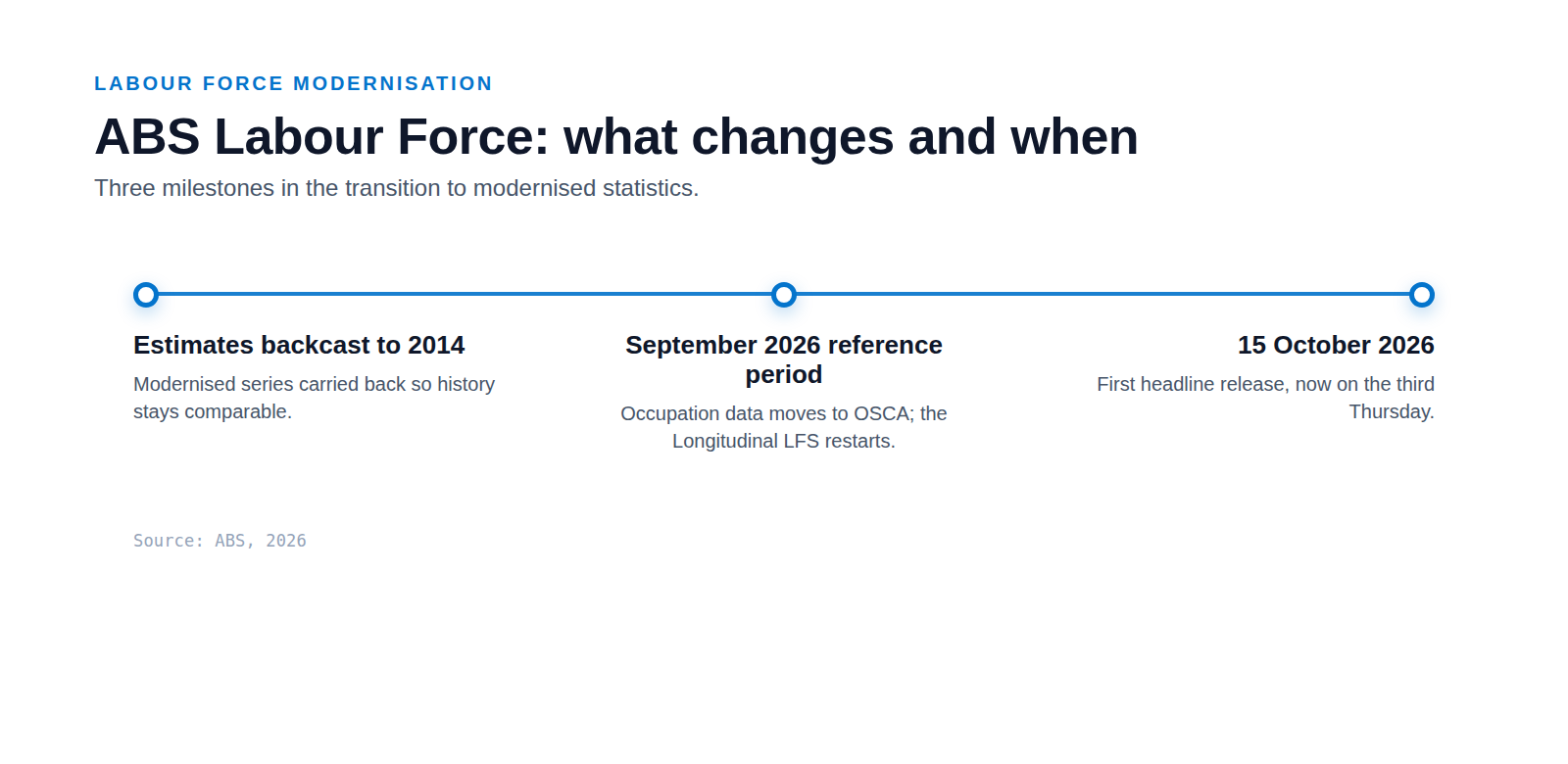
The ABS has set out four changes in one update. From the September 2026 reference period, every Labour Force Survey occupation figure is categorised using OSCA. The ABS has backcast OSCA estimates to 2014, so you can see the new categories running back over a decade. The Longitudinal Labour Force Survey restarts from the same reference period. And Labour Force, Australia returns to a fixed third-Thursday release, starting 15 October 2026. None of these is a small tweak if your work depends on the numbers, so it helps to take them one at a time.
- From the September 2026 reference period
- Occupation data moves to OSCA
- Available to 2014
- Backcast OSCA estimates
- 15 October 2026
- First third-Thursday headline release
- Restarts from the September 2026 reference period
- Longitudinal Labour Force Survey
Why this touches your pipeline, not just a report
A classification change is not only a headline story. If your pipeline joins tables on the old occupation codes, that join can break when the codes change. Worse, it can keep running while it quietly mismatches categories, so your numbers look fine and are wrong. Models trained on the old structure inherit the error. Dashboards built on those models pass it to the people who trust them, often without a warning that anything has shifted.
The risk here is silent, and silent problems are the ones that surface at the worst moment. A staffing lead asks why a demand line moved, a board paper cites a category that no longer maps cleanly, and the trail leads back to a join no one checked. It is far cheaper to test the change on your own schedule than to explain it after a stakeholder spots it first.
The new release calendar to diarise
Mark the new dates now, because your refresh jobs and your stakeholders both run on them. Labour Force, Australia returns to the third Thursday of the month. The next dates the ABS has listed are:
- Labour Force, Australia, September: 15 October 2026
- 19 November 2026
- 17 December 2026
- 21 January 2027
- 18 February 2027
The Longitudinal Labour Force Survey moves to the fourth Wednesday of each month, two days earlier than its pre-transformation schedule. If a scheduled job assumes the old timing, it can pull an empty or stale file and then run on it as if nothing were wrong. Update the calendar in your orchestration tool, not just in someone's memory.
Use the backcast series so your trends survive
A classification change usually breaks time series. This one does not have to. The ABS has backcast OSCA estimates to 2014, which means you can rebuild your trend lines against a single consistent history. Do that rather than stitching old codes onto new ones. A stitched series hides a join in the middle of your chart, and that join is where the wrong conclusions start. Rebuild against the backcast and your year-on-year comparisons stay honest, because every point on the line sits on the same classification.
A short migration checklist for your team
Here is a practical order of work. It suits a small analytics team with a week or two before the release.
- Find where occupation codes live in your pipeline, from raw pulls to the final dashboard field.
- Map the old occupation codes to OSCA, and write the mapping down so it can be reviewed.
- Adopt the backcast series to 2014 rather than stitching old and new together.
- Re-point refresh jobs to the new third-Thursday dates and the fourth-Wednesday longitudinal release.
- Validate a sample release before you trust it, and compare a handful of known figures against the source.
Get ahead of the October release
You have a short window. The first OSCA-based release is 15 October 2026, and the safest time to test your pipeline is before it arrives, not after a stakeholder spots a broken chart. Work through the checklist, rebuild against the backcast, and update your calendar this month. If you want a hand, visit our SkillsMap page at /subs-services/skillsmap to see how we keep workforce dashboards accurate through the OSCA change.
Sources
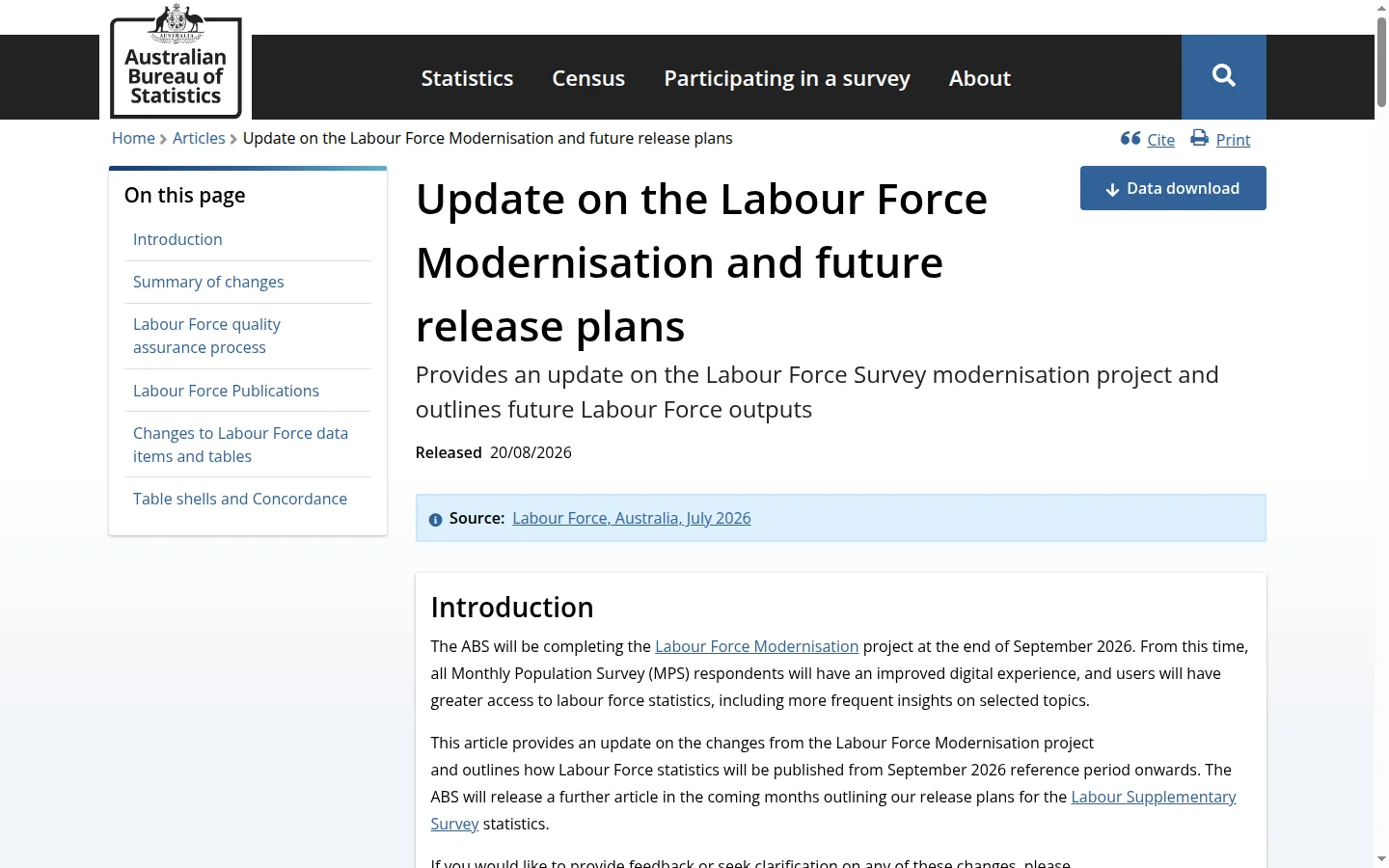
- Update on the Labour Force Modernisation and future release plans (accessed 2026-09-08)