From 1 October 2026, Support at Home personal care becomes fully funded. The Australian Government will cover personal care services delivered under the program, and eligible participants will stop paying contributions for tasks such as showering, dressing and continence support. The policy is settled. Your data is not. If you run finance, operations or reporting for an aged-care or community-care provider, your service catalogue, billing rules and dashboards still hold the old category, and the October reporting cycle is where the gap will show.
What changes on 1 October, in one paragraph
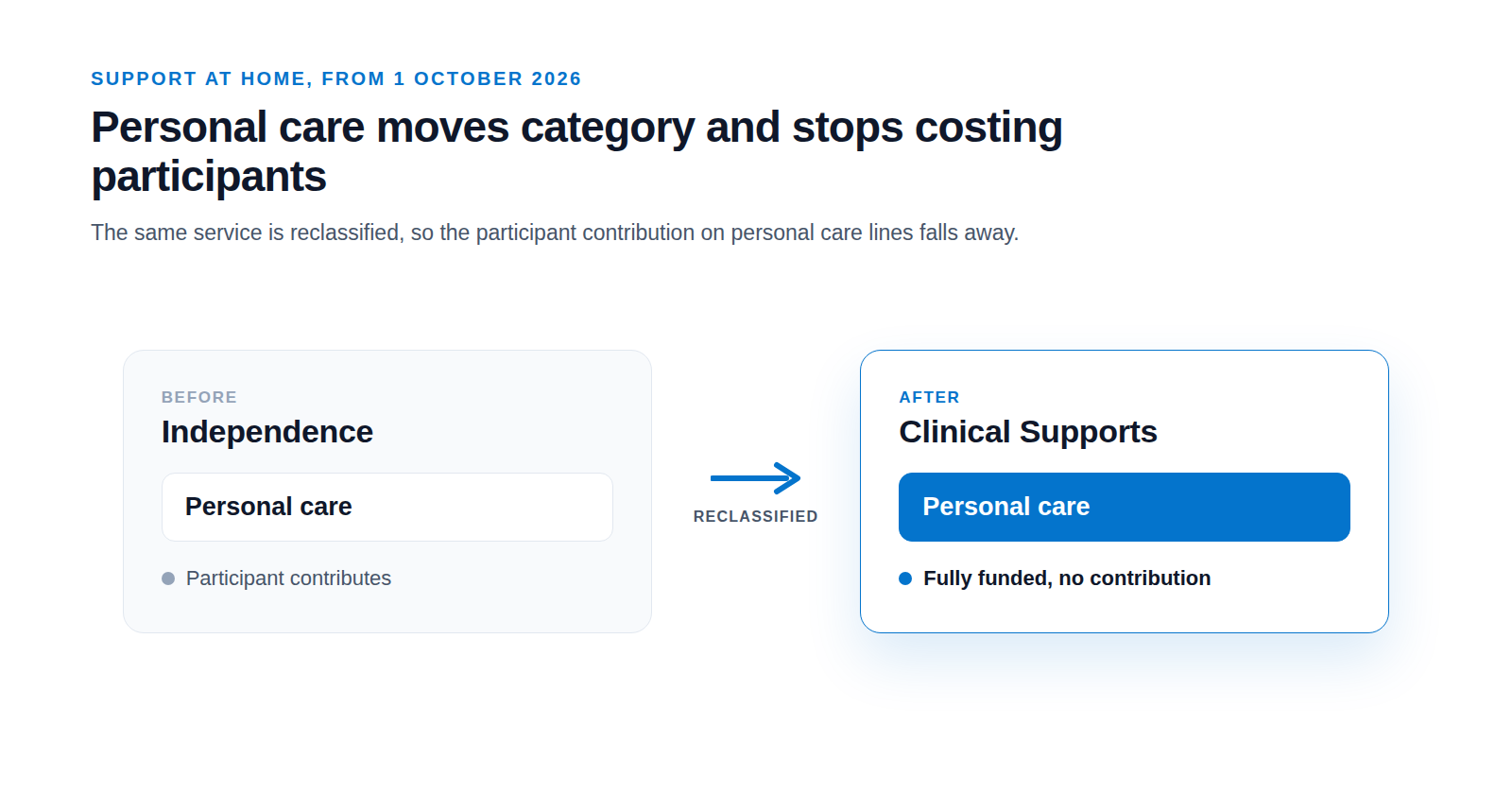
Here is the change in plain terms. All personal care services move from the Independence contributions category to the Clinical Supports contribution category. Participants who are assessed and approved for funding will no longer pay contributions for these services. Personal care here means showering, non-clinical continence management, dressing, eating, personal hygiene, and assistance with self-administration of medication. Eligible recipients do not need to do anything. The provider does. Other Support at Home categories are not affected by this change, so the work is targeted, not a full rebuild of your catalogue.
Why Support at Home personal care is a data problem, not just a policy update
The announcement reads like a policy note. In your systems it is a data change that lands in several places at once. Your service catalogue maps each personal care line to a contribution category. Your billing rules read that category to decide whether a participant pays. Your statements print what the participant owes. Your dashboards total contribution revenue and show it to the board. Every one of those layers still holds the old category.
Change the policy without changing the data, and two things can go wrong. You bill a contribution the participant no longer owes, which is a compliance and trust problem. Or you report a revenue picture that no longer matches the rules, which sends the board chasing the wrong question. Neither happens on purpose. Both happen because the category lives in more than one place and the effective date has to line up across all of them.
Treat this as a mapping and reconciliation job that you plan before 1 October, not a mess you clean up in November. The work is small if it is early and awkward if it is late.
The four data tasks to finish before the October cycle
Four tasks close the gap. Plan them together, tie them to the same effective date, and do them in order.
- Remap the service categories. Move every personal care line from Independence to Clinical Supports so the catalogue reflects the new rule.
- Switch off participant contributions on personal care lines from the effective date of 1 October 2026, and not a day before.
- Reconcile the transition period. Check the records that straddle the change so nothing is billed on the old rule after the effective date.
- Annotate the dashboards. Mark the date the change applied so anyone reading a revenue chart can see why the line moves.
Order matters. A remapped category with contributions still switched on will keep billing the participant. A contribution switched off without the remap will report against the wrong category. Both leave you reconciling by hand later.
Expect a step-change in contribution revenue, and label it
When personal care contributions stop, the contribution revenue you report will fall. That fall is expected. It is the policy working, not a broken pipeline and not a data fault. The risk is human: someone opens a quarterly report, sees the drop, assumes an error, and spends a week chasing a problem that was never there.
Get ahead of it. Brief the board before the number moves, so the fall is read as policy. Set the dashboard to annotate the change on the date it applied, so the explanation travels with the chart and no one has to remember it. A labelled step-change is a fact. An unlabelled one is a fire drill.
The same discipline helps your care managers. They read these dashboards daily, and a sudden unexplained drop erodes their trust in the numbers. A short note on the chart keeps that trust intact.
Keep an audit trail of when and how you applied the change
Record the effective date against the mapping change, and keep the before-and-after category for every line you move. You will want that trail for two reasons. First, reconciling the transition period is far easier when you can see the prior state. Second, a later query from the board, an auditor or a participant about when and how the change was applied is simple to answer when the record exists. A change with no date and no prior state is hard to defend months on.
If you use more than one system for billing and reporting, record the change in each, and confirm the dates match. A mismatch between systems is the most common source of a stray contribution after the effective date.
A short timeline so nothing catches you out
The change did not arrive overnight. Three dates set the context.
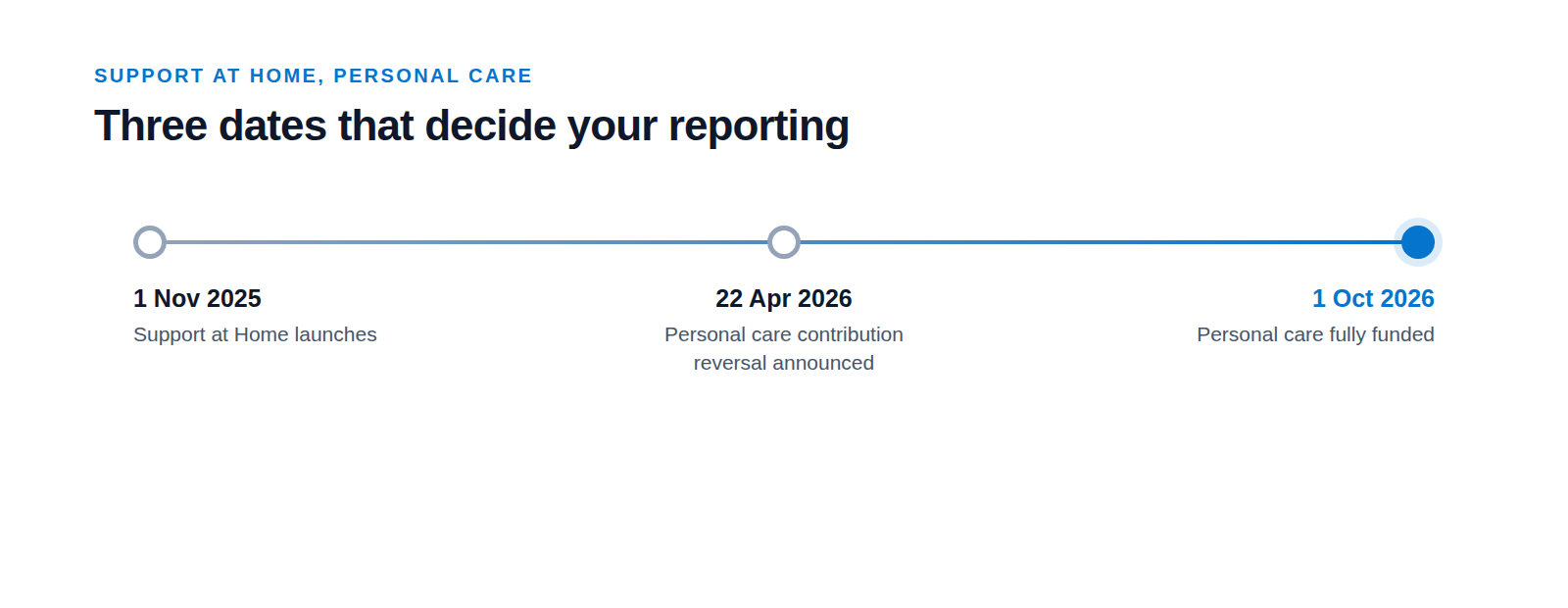
- 1 November 2025: Support at Home launched, replacing Home Care Packages and Short-Term Restorative Care.
- 22 April 2026: the reversal of personal care charges was announced.
- 1 October 2026: personal care becomes fully funded and contributions stop.
Print this timeline where your reporting team can see it, so the effective date is never in doubt.
What MERIT Vision would do
One clear next step
You do not need to solve all of this today. Take one action this month: pull your service-category mapping and your contribution rules, and confirm how each personal care line will behave on 1 October. If the mapping is right and the effective date is set, the reporting looks after itself. If it is not, you now know exactly what to fix before the cycle opens.