AI adoption in Australia is now common, but common is not the same as useful. New Treasury advice to the Treasurer describes the country's AI uptake as widespread but shallow. Around two-thirds of Australian businesses report some AI use, yet under 10 per cent report significant adoption. If your team has tried a chatbot, run a pilot, or watched staff paste work into a general tool, and none of it has moved a real number, you are the typical case, not the exception.
Widespread but shallow: what Treasury found about AI adoption in Australia
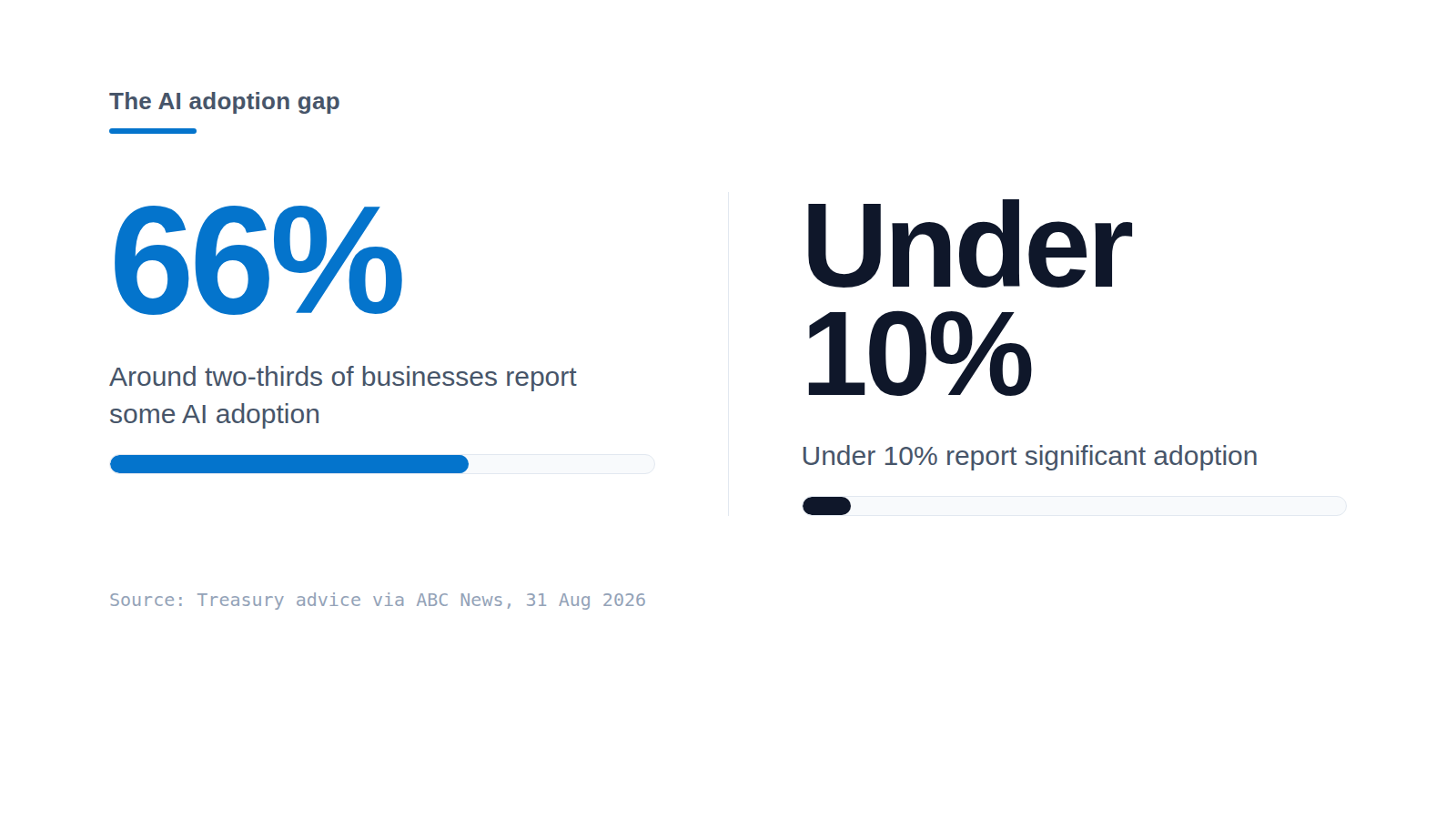
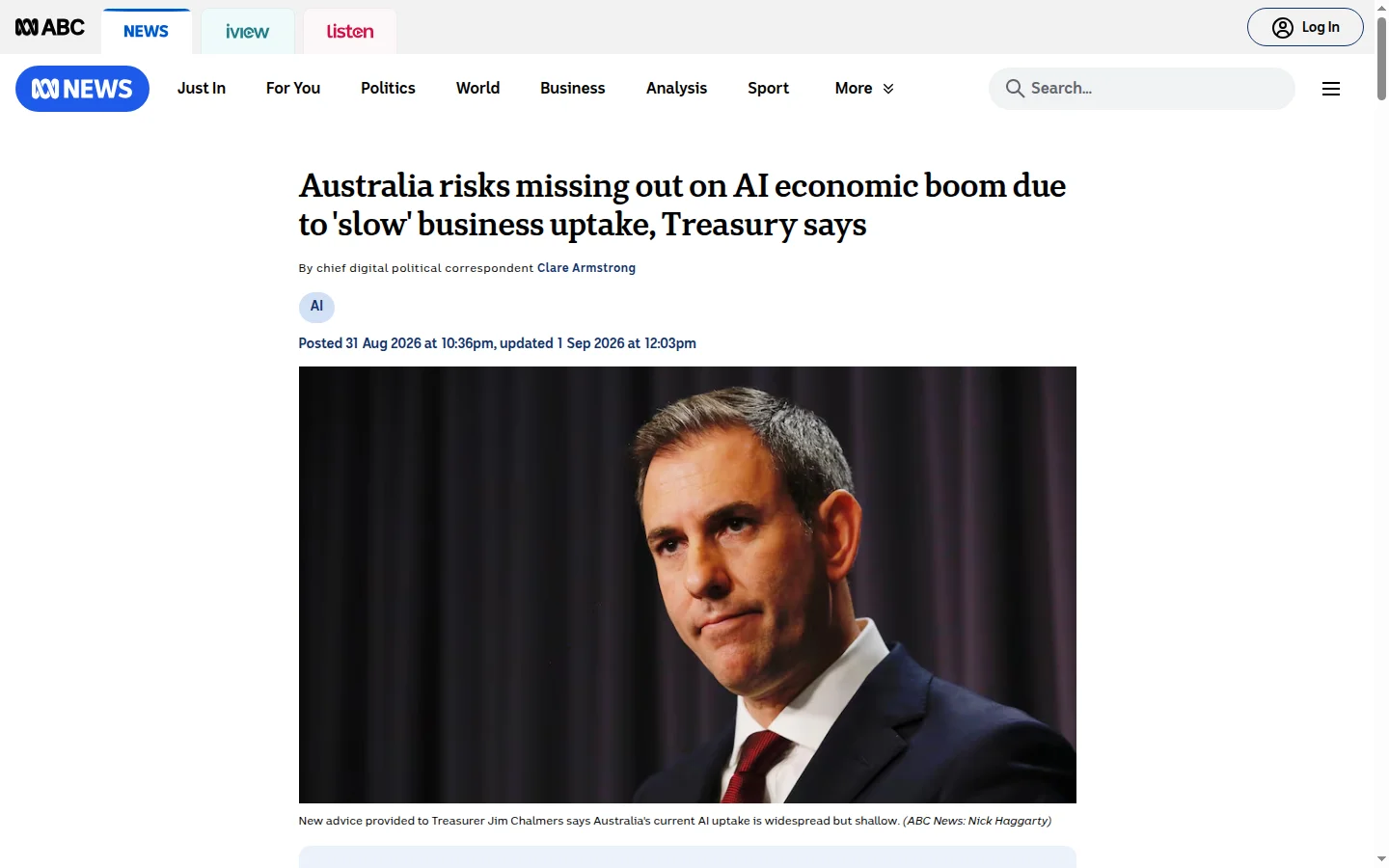
In advice to Treasurer Jim Chalmers, Treasury said AI uptake across Australian business is widespread but shallow. Around two-thirds of businesses report some AI adoption. Under 10 per cent report significant adoption. Most of the activity is a mile wide and an inch deep.
That gap matters because the value lives in the deep end. A tool touched in a dozen places changes nothing on its own. A tool wired into one workflow, measured against a baseline, can change a cost or a cycle time. The headline number looks healthy. The result number does not. So the honest question is not whether your organisation uses AI. It is whether any single use has changed something you can point to.
Why the pilot did not pay off
When a pilot produces a nice demo and then goes quiet, the model is rarely the problem. The problem is almost always underneath it. Three reasons come up again and again.
- The data was messy. The model was fed from a spreadsheet someone maintains by hand, or from a source that changes shape without warning, so the output could not be trusted twice.
- There was no baseline. No one wrote down what the cost, the cycle time or the error rate was before the pilot, so no one could say whether it improved.
- It was never wired into a workflow. The demo lived in a sandbox. The real process carried on beside it, untouched, so the pilot changed nobody's day.
Fix those three, and a modest use case starts to pay off. Skip them, and even a capable tool stays a demo forever.
Shallow versus deep: a simple test
You can tell a real deployment from a demo without a consultant in the room. Run the use case through this short checklist. If you cannot answer yes to most of it, the work is still shallow.
- Does it run on a data feed that refreshes on its own, not a file someone updates by hand?
- Did you record a baseline number before it started, so you can measure the change?
- Is it inside a real workflow, where a person or a system acts on the output?
- Is there one number it is meant to move, and can you see that number on a dashboard?
- If the person who built it left tomorrow, would it keep working?
The unglamorous groundwork that makes AI stick
Depth is built from ordinary parts. A reliable data pipeline that pulls from the source, cleans it, and lands it somewhere the tool can read every day. A measured baseline, written down before you start, so the before and after are honest. A dashboard that watches the one number the use case is meant to move, and flags it when it drifts. None of this is exciting. All of it is why a use case survives past the first month.
The pattern holds whether you are a council forecasting demand, a staffing agency matching candidates, or an aged-care provider tracking service data. The model gets the attention. The pipeline and the baseline do the work.
What the numbers say is at stake
Treasury put a range on the payoff. It called 1.5 to 2 per cent productivity growth a plausible upside from AI, with a realistic downside if uptake stays slow. The money moving into the field is large: global private AI investment reached almost half a trillion Australian dollars in 2025. The depth question is what decides which side of the range you land on.
- around two-thirds
- Australian businesses reporting some AI adoption
- under 10 per cent
- Businesses reporting significant AI adoption
- 1.5 to 2 per cent
- Plausible productivity growth upside (Treasury)
- almost half a trillion Australian dollars
- Global private AI investment in 2025
The wider economy is growing slowly: GDP rose 0.4 per cent in the June quarter 2026. In a slow economy, a use case that shaves a real cost or a real cycle time is worth more, not less. That is the case for depth over breadth. One deployment that moves a number beats ten pilots that do not.
Pick one use case and take it to production
You do not need a bigger AI budget to move from shallow to deep. You need one use case, the data groundwork under it, and an agreed number it has to move. Choose the use case where a small, reliable gain would matter most. Fix the pipeline, set the baseline, and watch the number. Then do the next one.
To see what deep adoption looks like in practice, read the MERIT Vision Case Studies, then pick one use case to take from pilot to production.
Sources
- Australia risks missing out on AI economic boom due to 'slow' business uptake, Treasury says (ABC News) (accessed 2026-09-09)
- Australian economy grew 0.4% in the June quarter (ABS) (accessed 2026-09-09)